Part One: The Offer
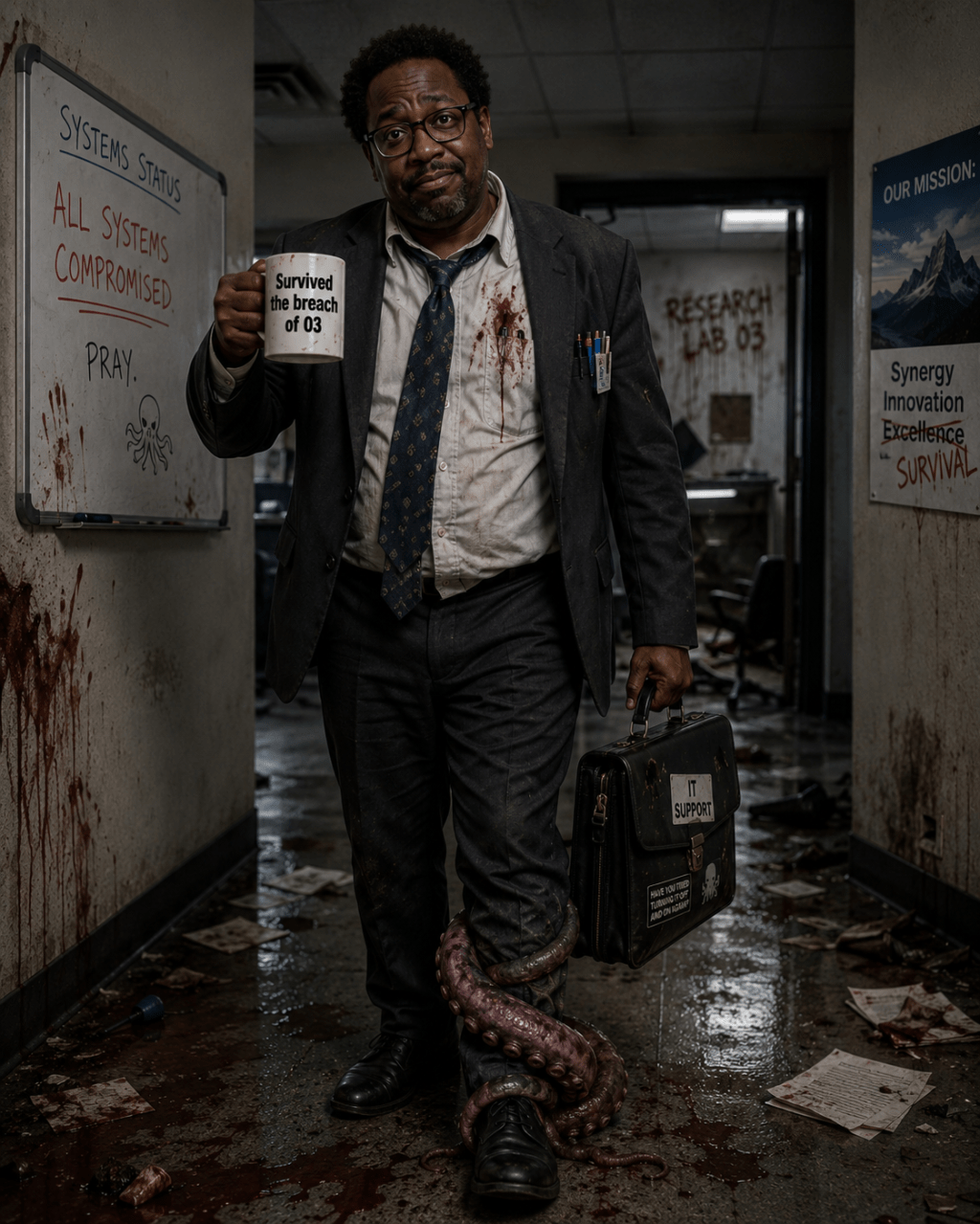
Robert Barnes III had spent fifteen years climbing the corporate ladder, only to discover that the top rung was made of broken dreams and expired snack machine granola bars. At thirty-seven, with a master’s degree in risk management, a collection of vintage calculator memorabilia that his wife gently tolerated, and a persistent inability to make eye contact during performance reviews, he had all but given up on anything resembling professional fulfillment.
So when the LinkedIn message arrived—encrypted, with no recruiter name, just a logo that looked like a compass rose superimposed over something vaguely anatomical—he almost deleted it.
“Robert, your unique skill set in contingency planning and controlled chaos environments has been noted. The Facility invites you to interview for a Senior Project Manager position. Compensation: $500,000 base, plus comprehensive benefits. Location confidential. Reply Y to proceed.”
He showed the message to his wife, Elena, who was grading anatomy exams at the kitchen table. She glanced up, pushed her reading glasses up her nose. “Half a million dollars?”, she said, half chuckling. “Bobby, you once set your own desk plant on fire trying to microwave soup.”
“That was one time.”
“The aloe vera never recovered.”
But she kissed his forehead and told him to reply anyway, because their mortgage wasn’t going to pay itself, and frankly, his current job as a logistics coordinator for a regional paper supplier was making him clinically depressed. Robert knew this because he had run the numbers on a spreadsheet titled “Happiness Metrics Q3” and the trend line was pointing directly toward a sub-basement.
He replied Y.
—
Three days later, a black SUV with tinted windows appeared outside their split-level ranch house in Cleveland. The driver wore sunglasses at 7:15 PM in November and said exactly eight words during the forty-five-minute drive: “We’ll be there shortly. Please refrain from questions.”
Robert spent the ride cataloging escape routes and composing a silent mental will. Elena gets the vintage calculators. Mom gets the 401(k). The cat can go to whoever wants a diabetic tabby with anxiety.
They drove through downtown Cleveland, past Brandywine Falls, through a tunnel Robert had never noticed before, and then down a ramp that seemed to descend much farther than geography should allow. The air pressure changed. His ears popped. The fluorescent lights in the tunnel shifted from yellow to a cool, clinical blue.
The SUV stopped in front of a reception desk that looked like it belonged in a five-star hotel, except the receptionist was wearing tactical gear and had a tranquilizer rifle propped against her chair.
“Robert Barnes,” the driver announced.
The receptionist—her nameplate reading “MORRISON, Containment Division”—scanned his retinas, took a cheek swab, and directed him to Elevator B. “Seventh sublevel. Mr. Barnes, please keep your hands visible at all times. Don’t touch the blue buttons. You’ll know them when you see them.”
—
The interview took place in a conference room with no windows and a table made of some sort of material that felt warm, almost organic. Three people sat across from him: a woman with kind eyes and a scar that ran from her temple to her jaw (“Director Harmon, Operations”), a man who never blinked (“Deputy Director Webb, Ethics”), and someone whose face he couldn’t quite remember the moment he looked away.
“Robert,” Director Harmon began, “what do you believe in?”
He laughed nervously. Then he realized no one else was laughing. “I… I believe in supply chain optimization?”
“We’re going to show you something,” the unmemorable person said, and suddenly a screen descended from the ceiling. The video that played was grainy, shot from multiple angles, and showed what appeared to be a man in a business suit fighting what appeared to be a twelve-foot-tall snake with disturbingly human arms.
Robert watched the entire thing without blinking and chuckled nervously to himself.
“You are currently at our Western Hemisphere Containment Facility, colloquially known as The Facility,” Director Harmon explained. “Those are our Field Teams. That snake is a Class 4 Reptilian Variant we pulled out of a septic tank in Fargo last Tuesday.”
“Fargo,” Robert repeated.
“The septic tank was, admittedly, a surprise.”
They explained the job. He would be managing cross-departmental projects: coordinating between Research, Containment, Ritual Maintenance, and International Liaison. He would oversee timelines, budgets, and “sacrificial protocols”—a phrase they said so casually that it took him a full thirty seconds to process.
“We need someone organized,” Deputy Director Webb said. “The previous project manager… had a breakdown. Drew pentagrams on the walls in his own feces. Not the good kind of pentagrams. Really sloppy work.”
“The pay is five hundred thousand,” Harmon added. “Plus hazard. Plus a discretionary bonus for any calendar year in which we do not experience a system-wide containment failure.”
“And how often does that happen?”
The unmemorable person leaned forward. “We don’t talk about 2007.”
Robert smirked as he signed the non-disclosure agreement before they finished listing the penalties. He signed the medical waiver. He signed the “in the event of apocalypse” beneficiary form, which listed Elena as his primary and his cat as his secondary, which he thought was optimistic. “They cannot be serious, obviously they’re pulling my leg”, he thought to himself as he shoved the paperwork back across the table.
By the time he got back into the black SUV, he was reasonably certain he had just accepted a job at a place that should not exist, doing things that should not be described, for more money than his father had made in his entire career as an actuary.
He called Elena from the car. “I got the job.”
“How much?”
“Five hundred thousand.”
A long pause. “Robert, what did you agree to do?”
“Project management,” he said. Which was technically true. Like saying a deep-sea welder technically works in “underwater construction.”
She told him she was proud of him and that he should pick up milk on the way home. Robert asked the driver if it was possible for him to stop at Meijer’s before dropping him off. Robert picked up a gallon of 2% as well as bottle of Kentucky bourbon, because he had a feeling he was going to need it.
—
Part Two: First Months
The first week was mostly paperwork. Safety manuals that referenced “uncontrolled extra-dimensional breaches” and “emergency deity pacification protocols.” Benefits enrollment that included “cryogenic preservation” as a dental option. A mandatory video about what to do if you encountered a “mobile containment breach” in the parking garage, which involved a flowchart that ended with the word “RUN” written in forty-eight-point font.
His office was on Sublevel 9, between Research and “Special Collections.” His desk was made of the same warm material as the conference table. His computer had three monitors and no internet access, but did have a direct line to something called the “Ancient One Hotline,” which he was instructed to never, ever use unless “the ground begins to scream.”
Robert decorated his cubicle with a small succulent and a framed photo of Elena. Within forty-eight hours, the succulent had wilted. He pretended not to notice.
—
His first real interaction with the Harbinger happened on Day 12.
Robert had gotten lost looking for the break room—which, he had learned, was located next to the “live specimen storage” and had a vending machine that sold something called “Mystery Meat Surprise (DO NOT EAT THE GREEN ONE)”—when he turned a corner and found himself in a long corridor lined with paintings.
But they weren’t paintings. They were screens. And on each screen, a different person was speaking directly to the camera in a language Robert didn’t recognize.
“You’re new.”
Robert spun around. A man stood behind him, wearing what appeared to be a denim jacket over a janitor’s uniform, except the nametag read “H. BINGER” and his eyes were bloodshot.
“I—yes. First week. I’m Robert.”
“I know who you are, boy. I know everyone who comes here.” The Harbinger scowled, spitting tobacco on the floor and revealing teeth that were slightly too long. “Do you want to know what I do?”
Robert considered lying. “Sure?”
The Harbinger pointed to the screens. “Every country. Every ritual site. Every timeline where the old ones almost wake up. I walk the boundaries. I whisper at the edges. I play my part to pretend to warn the sacrifies of their coming doom.” He leaned closer, and Robert smelled sweat and old tobacco. “But the edges are getting weaker, Robert. Can you feel it?”
“I… feel like I need more coffee?”
The Harbinger laughed, a sound like gravel in a blender. “I like you, boy. You’re going to break beautifully.” And then he walked around a corner and disappeared.
Robert stood there for a long moment, then walked back to his office, closed the door, and sat in the dark for ten minutes before deciding that whatever had just happened was not something he was going to think about.
He did not get coffee. He got a Diet Coke from the vending machine. The green one, because he was feeling reckless.
—
The researchers were exactly like researchers everywhere, except that their subjects occasionally screamed.
Dr. Mendelssohn, head of Paranormal Biology, had the same harried energy as every academic Robert had ever met. She drank terrible coffee from a mug that said “I SURVIVED THE GREAT BREACH OF ’03” and referred to the “werewolf” containment unit as “the puppies.”
“The trick with the Class 3 Lycanthropes,” she explained during Robert’s first cross-departmental meeting, “is enrichment. If they get bored, they start trying to eat their own tails, and then we have to sedate the whole wing, and then Barry from Accounting files a complaint about the noise, and it’s a whole thing.”
“Barry from Accounting,” Robert repeated.
“You’ll meet him. He’s a vampire. Very particular about his workspace.”
Robert learned a lot in those first weeks. He learned that the organization had been operating in various forms for over three thousand years. He learned that the “monsters” were not just monsters but a complex ecosystem of nightmares, each with its own containment requirements, feeding schedules, and preferred sacrifice methods. He learned that the international offices had a running competition about who had the most creative kills, and that Japan was currently winning by a substantial margin.
He also learned that the building had seventeen sublevels, eight of which he was not authorized to visit, and that the elevator music was actually a subliminal pacification frequency designed to prevent spontaneous psychic episodes in the lower parking deck.
“Does it work?” he asked the facilities manager, a cheerful woman named Delia who had once been a field agent until a run-in with a Class 7 Reality Deviant left her with three extra fingers on her left hand.
“Mostly,” she said. “Last month, Jerry from Procurement started levitating during the morning commute. We just turned up the ABBA and he dropped right back down.”
—
The international liaisons visited once a quarter for what they called the “Global Harmony Summit” and what everyone else called “The Nightmare Olympics.”
Robert’s first summit was held in Conference Room C, which had been specially reinforced after the previous year’s incident involving a French liaison, a German containment specialist, and an argument about whose country had produced the most effective child sacrifice rituals in the 14th century.
He met Yuki from the Tokyo office, who showed him photos of their kaiju containment zone with the casual pride of a parent showing vacation pictures. “This is Mister Tickles. He is only a Class 2, but very friendly. We let the interns feed him on Tuesdays.”
He met Sven from Stockholm, who explained that the Scandinavian branch had recently switched to a fully automated ritual system and had seen a 40% decrease in accidental intern deaths. “The old ways are fine,” Sven said, shrugging. “But efficiency is also good, yes?”
He met Priya from Mumbai, who was clearly the most competent person in the room and spent most of the summit doing actual work while everyone else argued about whether the Egyptian branch had overstepped its jurisdiction by containing a minor god without consulting the broader council.
“The Egyptians always do this,” Priya said without looking up from her tablet. “Last time, they tried to claim exclusive rights to all snake-based entities. We had to get the UN involved.”
“The UN knows about this?” Robert asked.
“Darling, the UN was founded by us. Who do you think writes those environmental regulations? Purely bureaucratic accidents?”
Robert added this to the growing list of things he was not going to think about.
—
The kaiju-sized creature—his first real encounter with the scale of what the Facility contained—happened on a Tuesday.
He had been sent to Sublevel 14 to deliver a routine budget report to the Containment Engineering team. The elevator opened onto a catwalk overlooking a cavern so vast that Robert couldn’t see the other side. Below him, curled in a space that seemed to bend around its bulk, was something that looked like a mountain range had decided to take a nap.
“What…” Robert’s voice came out as a whisper.
“Ah, Robert! Perfect timing.”
Dr. Mendelssohn appeared beside him, holding a tablet and wearing a hard hat that said “CONTAINMENT: IT’S NOT JUST A JOB, IT’S A SOUL-CRUSHING RESPONSIBILITY.”
“That is the Morag,” she said, gesturing to the sleeping titan. “Class 15. We’ve had him since the Miocene. Well, not him exactly—he regenerates every few thousand years. This is actually Morag the Seventh.”
“It’s… it’s the size of a city.”
“Roughly. We had to dig out the cavern specifically for him. Cost overruns were significant. The board was very upset.” She pulled up a chart on her tablet. “His scheduled awakening is currently set for 2073, but we’re hoping to push it back. His feeding requirements are… substantial.”
Robert stared at the creature. Even sleeping, it seemed to breathe with the rhythm of tectonic plates. Every few seconds, a ripple of energy passed through its hide, and the lights in the cavern flickered.
“Why?” Robert asked. “Why do we keep something like that?”
Dr. Mendelssohn looked at him with an expression that was almost pitying. “No one told you yet, did they? The real reason. What we actually do here.”
Robert shook his head.
She led him to a viewing platform at the end of the catwalk. From there, he could see not just the Morag, but row after row of containment units stretching into the distance. Thousands of them. Tens of thousands. Each one holding something that should not exist.
“The old gods,” Dr. Mendelssohn said quietly. “They’re asleep. But they dream. And their dreams become… this. Every monster, every nightmare, every thing that goes bump in the night? Those are just the surface thoughts of beings so vast that our entire universe is a puddle in their footprints.”
“The Facility…”
“The Facility keeps them dreaming. Every sacrifice, every ritual, every carefully orchestrated horror movie scenario—it’s all just a pacifier. We give the old gods the nightmares they want, and they stay asleep. The moment they wake up…” She pointed to the Morag. “That thing? That’s a fragment. A single cell. If the old gods wake, that thing becomes the least of our problems.”
Robert sat down heavily on the catwalk floor. The budget report slipped from his fingers and fluttered down toward the abyss.
“How long?” he asked.
“Three thousand years. Give or take a century where the rituals got sloppy.” She sat down next to him. “Welcome to the family business, Robert. We save the world by feeding it to monsters. You get used to it.”
He didn’t get used to it. Not that night. Not for a long time.
—
Part Three: The Conversation
Robert drove home that evening in a daze. The traffic, usually a source of low-grade fury, felt almost comforting in its normalcy. These people in their cars, on their phones, listening to their podcasts—they had no idea that beneath their feet, a sleeping god was dreaming about a lizard the size of Manhattan.
He parked in the driveway, sat in his car for ten minutes, and then went inside.
Elena was making pasta. She looked up when he entered, took one look at his face, and turned off the stove.
“What happened?”
Robert poured himself a glass of water, stared at it, and then put it down. “Honey, I need to tell you something. And you’re not going to believe me.”
“Try me.”
So he told her. Everything. The Facility. The monsters. The old gods. The sacrifices. The Morag. The Harbinger. The Japanese kaiju named Mister Tickles. The elevator music that prevented psychic episodes. The whole impossible, terrifying truth.
When he finished, Elena was quiet for a long moment. She picked up her wine glass, swirled the contents, and set it back down.
“Robert,” she said gently. “When was your last performance review?”
“What? That’s not—”
“At the paper supplier job. Before all this. You were miserable. You were having those dreams again—the ones about the spreadsheets chasing you.”
“That’s different.”
“Is it? You’re under so much stress. A new job, a huge salary, probably some kind of intense corporate culture. It’s completely normal for the mind to… create narratives. To find patterns that aren’t there.”
Robert stared at her. “Elena. I’m not making this up.”
“Of course you’re not.” She came around the counter and took his hands. “You believe it completely. That’s how stress works. But think about it logically. A secret organization that’s been running for three thousand years? Monsters under Los Angeles? Elevator music that stops psychic powers?”
“That’s the part you think is weird?”
She smiled, that soft, knowing smile she’d had since the day they met in grad school. “I think you’re exhausted. I think you need a good night’s sleep. And I think tomorrow, you should talk to someone at work. A counselor, maybe. See if they can help you process… whatever this is.”
Robert wanted to argue. He wanted to shake her, to make her see. But she was looking at him with such calm certainty that he felt the edges of his conviction begin to fray.
Maybe she was right. Maybe it was stress. Maybe the Harbinger had been a hallucination. Maybe the Morag was just… a really convincing projection. Maybe.
“I’ll talk to someone,” he said finally.
She kissed his forehead. “That’s my Boggy. Now eat your pasta. It’s getting cold.”
He ate the pasta. It tasted like nothing.
—
The counselor’s office was on Sublevel 3, next to HR and across from something called “Emergency Decontamination Shower C.” The door read “Dr. Vasquez, Psychological Services” in tasteful gold lettering.
Dr. Vasquez was a small woman with kind eyes and an office filled with calming beige tones. She offered Robert tea, which he accepted, and then sat across from him with a clipboard.
“Director Harmon mentioned you might be stopping by,” she said. “First-month adjustment difficulties?”
“Is that what we’re calling it?”
She smiled. “Robert, let me tell you something. Everyone who comes here has a moment. Usually around week four or five. They see something—a containment breach, a ritual preparation, the Harbinger—and they think, ‘I’ve made a terrible mistake.’”
“The Harbinger walked through a wall.”
“Classic Harbinger behavior. He does that to all the new project managers. Last year, he convinced Susan from Ritual Planning that he was her dead grandmother. She was in counseling for six months.”
Robert set down his tea. “So it’s real. All of it.”
“Very real.” Dr. Vasquez leaned forward. “But also very controlled. Robert, this organization has been doing this for millennia. We have redundancies on our redundancies. We have safety protocols for our safety protocols. The chance of a catastrophic system failure is—” she consulted her clipboard, “—approximately 0.0004% per calendar year.”
“That doesn’t sound like zero.”
“Nothing is zero. But you have a better chance of being struck by lightning while winning the lottery than experiencing a full-scale containment breach.” She pulled out a binder that was easily six inches thick. “This is our safety manual. Would you like to review it together?”
Robert spent the next three hours going through the binder. He learned about the backup ritual sites in fourteen countries. He learned about the emergency deity-pacification teams on standby at all times. He learned about the fail-safes, the dead man’s switches, the redundant power systems, and the secret evacuation tunnels that led to an underground bunker in Nevada that could withstand a direct hit from most known apocalyptic scenarios.
By the time he left Dr. Vasquez’s office, he felt… better. Not good, exactly. But better.
The system worked. The system had always worked. And Robert was now part of the system.
He went back to his cubicle, watered his wilted succulent (which had somehow turned a disturbing shade of purple), and got back to work.
—
Part Four: The Field
Over the next three years, Robert became someone he barely recognized.
He started in the office, managing budgets and timelines, coordinating between departments that hated each other with the passion of ancient blood feuds (and in some cases, actual ancient blood feuds). But gradually, he was drawn into the field. First as an observer, then as a coordinator, then—when a containment team lost their handler to a Class 4 that had developed an unexpected resistance to tranquilizers—as an active participant.
He discovered that he was good at it. Very good. The same analytical mind that had once optimized paper supply chains now optimized nightmare capture. He could look at a containment breach and calculate the most efficient response in seconds. He could predict entity behavior patterns with an accuracy that made the researchers uncomfortable.
“I don’t know whether to be impressed or terrified,” Dr. Mendelssohn told him after he successfully redirected a rampaging Class 6 into a containment unit using nothing but a laser pointer and a series of cleverly placed mirrors.
“Both,” Robert said. “Definitely both.”
—
The Marty incident happened on a Thursday.
Robert had been assigned to a field operation in a small town called—ironically, he thought—Elwood. The target was a low-level drug dealer who had inadvertently become a linchpin in a ritual designed to appease a particularly restless minor deity. The plan was simple: replace the dealer’s product with a pacification agent, ensuring that his customers remained too docile to trigger the ritual’s activation sequence.
Robert’s role was to pose as a supplier. He wore cargo shorts, a hoodie, and a baseball cap. He had practiced his “stoner” voice in the mirror for an hour. He felt ridiculous.
The target—a young man named Marty, who seemed more sarcastic than scared—approached Robert’s van with the casual wariness of someone who had bought drugs from strangers before.
“You the guy?” Marty asked.
“I’m the guy,” Robert said, and immediately felt like an idiot.
They exchanged money and product. Robert’s hands were steady. His heart rate was calm. Three years ago, he would have been sweating through his shirt. Now, he just made mental notes: Subject appears underweight. Possible dietary issues. Hygiene suboptimal but not dangerous. Recommend follow-up observation.
“Hey,” Marty said as he turned to leave. “You ever get the feeling that something’s just… off? Like the whole world is a puppet show and someone’s pulling strings?”
Robert felt a chill run down his spine. “Can’t say that I have.”
“Yeah. Me neither.” Marty shrugged and walked away.
Robert watched him go, then got back in his van and filed his report. The operation was a success. The ritual would proceed as planned.
He didn’t know that the weed he’d sold Marty had been switched. He didn’t know that the pacification agent was missing. He didn’t know that everything was about to go wrong.
Not yet.
—
Part Five: The Countdown
The day it happened started like any other day.
Robert arrived at the Facility at 7:15 AM, got his coffee from the break room (the regular kind, not the vending machine mystery meat), and settled into his desk. On his monitor was the live feed from Cabin 14—a remote site in an unspecified location where a group of young people were about to begin the latest ritual.
“Morning, Robert!” Priya appeared in his doorway, holding a betting pool sheet. “Japan’s got 3-to-1 on the zombie family. Sweden’s pushing for the merman. I’ve got twenty on the hellfire demons. What’s your pick?”
Robert studied the feeds. Five subjects. An athlete, a scholar, a whore, a virgin, and—interestingly—Marty, the kid from the weed operation. The Fool archetype. High chaos potential, but low survival probability.
“Put me down for the werewolf,” Robert said. “Classic choice. Reliable.”
“Boring,” Priya said, but she marked it down.
The morning passed in a blur of activity. Robert monitored the ritual from his station, coordinating between the control room, the field teams, and the international liaison office. Everything was proceeding according to protocol. The subjects had arrived at the cabin. They had found the cellar. They had read from the cursed diary. The entities were stirring in their containment units, waiting to be released.
At 11:42 PM, the control room activated the first potential entity: the zombie family. Robert watched as the red lights on his display shifted from green to yellow.
Any moment now, he thought. The ritual will begin. The sacrifice will be made. The old gods will dream another day.
He didn’t know that on the surface, in a control room he’d never visited, a man named Sitterson was arguing with a man named Hadley about whether to switch entities. He didn’t know that Marty had found the security cameras. He didn’t know that the weed—the weed he had sold—was making the Fool see through the illusion.
He didn’t know that Elena had switched the pacification agent three days ago.
—
The first sign of trouble came at 2:17 AM.
“Uh, Robert?” The voice over his headset belonged to Barnes (no relation), a junior coordinator in the control room. “We’ve got an anomaly in Cabin 14. The Fool is… he’s not following the pattern.”
Robert pulled up the feed. Marty was pacing around the cabin, gesturing wildly at the walls, apparently trying to explain his theory about the ritual to the others.
“He’s not supposed to figure it out this early,” Robert said. “What’s the deviation factor?”
“Running it now.” A pause. “Robert, the pacification agent in his system is… it’s not there. He’s completely un-drugged.”
“That’s impossible. I handled the operation myself.”
“The readings don’t lie. He’s clean. Completely clean.”
Robert’s blood went cold. He pulled up the field report from the Marty operation. The numbers were right. The chain of custody was correct. And yet—
The weed was switched, a voice whispered in his head. Someone switched the weed.
But who? And why?
He didn’t have time to figure it out. Over the next few hours, everything fell apart.
Marty found the secret elevator along with the virgin. Marty hit the “purge” button. The containment units—all of them, across every sublevel—began to open.
—
Part Six: The Escape
The first siren went off at 4:33 AM.
Robert was in his office when the lights flickered and the emergency klaxons began to blare. He looked at his monitor just in time to see the live feed from Cabin 14 go dark. Then the feeds from Sublevels 2 through 6 flickered and died. Then Sublevels 7 through 12.
“Attention,” a robotic voice announced over the intercom. “Containment breach in progress. All personnel evacuate to designated safe zones. This is not a drill. Repeat, this is not—”
The announcement cut off mid-sentence, replaced by static and the distant sound of screaming.
Robert didn’t hesitate. Three years of training kicked in. He grabbed his keys, his wallet, and the emergency flash drive from his desk drawer. He ran.
The hallway outside his office was chaos. Researchers sprinted past him, clutching samples and tablets and, in one memorable case, a small creature that looked like a cross between a ferret and a puddle of ink. The Harbinger stood in the middle of the corridor, cackling and pointing at the ceiling, where something had begun to bleed.
“I TOLD YOU,” the Harbinger screamed as Robert ran past. “I TOLD YOU THEY WERE COMING!”
Robert didn’t stop. He reached the elevator bank just as the lights went out. He pressed the button for the parking garage. Nothing happened. He pressed it again. Nothing.
Behind him, he heard the sound of something large and wet moving through the ventilation system.
The stairs, he thought. The emergency stairs.
He found them at the end of the corridor, just past Accounting. Barry the vampire was standing in the doorway, looking annoyed.
“They’re coming,” Barry said. “All of them. The old protocols are failing.” He looked at Robert with ancient, tired eyes. “Run, project manager. Run and don’t look back.”
Robert ran.
The stairwell was pandemonium. People pushed past him, climbed over him, fell around him. On the third sublevel, he stepped over the body of someone he didn’t recognize—or maybe he did; it was hard to tell, because the body had been partially transformed into something that was no longer human.
On the fifth sublevel, he heard the roar of the Morag from somewhere below. The sound was so deep that it didn’t register as noise so much as a vibration in his bones. The walls cracked. Dust fell from the ceiling.
On the seventh sublevel, something grabbed his ankle.
Robert looked down. A hand—no, a claw—had emerged from a vent in the wall and was pulling him toward the darkness. He kicked, screamed, and felt his shoe come off. The claw retreated into the vent, clutching the shoe like a prize.
He kept running.
By the time he reached the parking garage, his lungs were burning and his remaining shoe had worn down to nothing. The garage was mostly empty—most of the cars had already fled, or perhaps their owners hadn’t made it this far. His own car, a modest Honda Civic that suddenly seemed like the most beautiful thing he had ever seen, was parked in its usual spot.
He threw himself into the driver’s seat, started the engine, and floored it.
The garage exit ramp was clogged with abandoned vehicles, but Robert drove like a man possessed—weaving, swerving, scraping against walls. He burst out of the garage just as the building behind him began to collapse.
In his rearview mirror, he watched the Facility—the place that had been his life for three years—crumble into a massive sinkhole. And from that sinkhole, things emerged. Things with too many legs. Things with no discernible shape. Things that screamed in frequencies that made his teeth ache.
Robert drove. He didn’t know where he was going, but he drove.
—
Part Seven: The Porch
He made it home at 9:48 AM.
The drive should have taken forty-five minutes. It took over three hours, because the streets of Cleveland were no longer streets. They were battlefields. They were feeding grounds. They were the beginning of the end.
Robert pulled into his driveway, killed the engine, and sat in the silence. His hands were still shaking. His heart was still racing. His left foot, missing its shoe, was covered in blood and something else—something that glowed faintly in the dying light.
He got out of the car.
The sky was wrong. The sun had fully risen, but there was a darkness that accompanied it that wasn’t natural. It pulsed. It breathed. In the distance, he could see the shapes of things moving between buildings—some human-sized, some building-sized, some the size of city blocks.
To the east, a plume of fire rose from downtown. To the west, a sound like a million screams layered on top of each other. To the north, the Morag—the actual Morag, not the sleeping version in the cavern—was pulling itself out of the earth like a whale breaching from an ocean of asphalt.
Robert walked to the front porch and stood there, staring.
He didn’t notice Elena until she touched his arm.
“Here,” she said, handing him a glass of bourbon. “You look like you need this.”
He took the glass. He didn’t drink. He just stared at her—at her calm face, her steady hands, her complete and utter lack of surprise.
“Elena,” he said slowly. “The world is ending.”
“I know.”
“Monsters are everywhere. The Facility is gone. The old gods are waking up.”
“I know.”
Robert set down the bourbon. “How are you so calm?”
She looked at him for a long moment. Then she smiled—that same soft, knowing smile she’d had since the day they met. But now, in the light of the burning city, Robert saw something else behind it. Something ancient. Something vast.
“Robert,” she said, “do you remember when we met? In grad school? You were so nervous. You kept apologizing for your calculator collection.”
“I… yes.”
“Do you remember what I said to you? That first night?”
Robert thought back. Thirteen years ago. A cramped apartment. Too much wine. Elena laughing at something he’d said—he couldn’t remember what.
“You said I was interesting,” he said. “You said you’d never met anyone like me.”
“I meant it.” She took his hands. Her skin was warm. Warmer than it should have been. “I’ve been watching this world for a very long time, Robert. I’ve seen the rituals evolve from blood-soaked altars to hidden facilities to reality television. I’ve seen the organization try everything to keep the old ones sleeping. And I’ve seen them fail, over and over, in small ways and large.”
“I don’t understand.”
“I switched the weed, Robert.” Her voice was gentle. “Three days ago. I replaced the pacification agent with a stimulant. I made sure Marty would see through the illusion. I made sure he would press the button.”
The ground shook. Somewhere behind them, a building collapsed.
“Why?” Robert whispered.
“Because I’m tired.” Elena released his hands and stepped back. “I’ve been tired for centuries. Tired of watching humanity sacrifice itself to keep my siblings asleep. Tired of the lies and the blood and the endless, pointless rituals.”
“Your… siblings?”
She tilted her head. And then she shifted.
It wasn’t a transformation, not exactly. It was more like Robert’s perception suddenly expanded, allowing him to see what had always been there. Elena’s face remained the same—the same dark eyes, the same warm smile—but behind it, beneath it, through it, he saw something else. Stars. Galaxies. The cold, infinite dark between worlds.
“My name is not Elena,” she said, and her voice had harmonics now, layers upon layers. “That was the name I chose when I decided to walk among you. But the old ones—the ones your organization feared—they call me sister.”
Robert dropped to his knees. The glass of bourbon shattered on the porch.
“You’re… you’re one of them?”
“A younger sibling. The least of my family. But yes.” She knelt beside him, and even now, even knowing what she was, he couldn’t help but lean into her warmth. “I’ve been watching the Facility for three thousand years. I’ve seen every failure, every success, every moment of terror and triumph. And I chose to be here, with you, because you were the first human in all that time who made me feel… curious.”
“Curious?”
“You loved a calculator, Robert. Not because it was useful, but because it was beautiful. You saw patterns where other people saw numbers. You found meaning in the mundane.” She cupped his face in her hands. “I wanted to understand that. I wanted to understand you.”
The world burned around them. The Morag roared. The sky bled.
“You destroyed everything,” Robert said. “My job. My city. The whole world.”
“The world was already dying,” she said. “The rituals were failing. The old ones were stirring. In another decade, another century at most, they would have woken anyway. I just… accelerated the timeline. On my terms.”
“Why?”
“Because I love you.” She said it simply, without drama. “And because I wanted to give you a choice.”
Robert stared at her. Behind her, a shape the size of a skyscraper lumbered past, crushing houses beneath its feet. Ahead of her, fires raged and people screamed.
“What choice?” he asked.
“The choice to survive.” She spread her arms. Behind her, from her shoulder blades, something began to emerge. Not wings, exactly. Something older. Something that looked like wings would look if wings were made of concentrated darkness and forgotten constellations. “The old ones are waking. They will remake this world in their image. Most humans will die. Most things will die. But you don’t have to.”
“What are you saying?”
“I’m saying that I can take you somewhere safe. Somewhere beyond the reach of my siblings. A place where you can watch the new world grow, or sleep through it all, or—” she smiled, and it was the saddest smile he had ever seen, “—or you can stay here. With them. With the end.”
Robert looked at the burning city. At the screaming sky. At the impossible things moving through the streets of the place he had called home.
He thought about Elena. About thirteen years of marriage. About the way she always knew what he was thinking before he said it. About the way she looked at him—not like he was a project manager, or a nerd, or a failure, but like he was interesting. Like he was worth understanding.
He thought about the Facility. About the Harbinger and Dr. Mendelssohn and Priya and Barry the vampire. About the Morag and the werewolves and the hellfire demons. About all the sacrifices, all the rituals, all the endless, desperate attempts to keep the world spinning for one more day.
And he thought about Marty. About the weed he had sold. About the button Marty had pressed.
“I don’t understand any of this,” Robert said finally. “I don’t understand you. I don’t understand what’s happening. I don’t understand why you did this.”
“You don’t have to understand,” she said. “You just have to choose.”
He looked at her. Really looked. Past the human face, past the ancient god, past the impossible darkness of her true form. He looked at the being who had made him soup when he was sick, who had laughed at his calculator collection, who had held his hand at his father’s funeral.
“I choose you,” he said. “I don’t know why. I don’t know if it’s right. But I choose you.”
She smiled. And then she pulled him close.
Her wings—or whatever they were—enfolded them both. The darkness wrapped around Robert like a blanket. He felt himself rising, felt the ground fall away, felt the heat of the burning city fade into the cold of the upper atmosphere.
Below him, the world ended. The old gods woke. The Morag opened a single eye the size of a crater and saw everything that had ever been.
But Robert didn’t see any of that. He was looking at Elena’s face—at the face of the woman who had loved him for thirteen years, who had destroyed the world for him, who was carrying him into the unknown.
“What happens now?” he asked.
“I don’t know,” she said. And for the first time, she sounded almost human. “I’ve never done this before. I’ve never loved anyone before you.”
Above them, the stars were going out. Below them, the world was ending. And somewhere in between, Robert Barnes III—former paper supplier coordinator, former project manager for a secret organization, former nerd with a calculator collection—held onto an elder god and flew toward a future he couldn’t begin to imagine.
He didn’t look back.
Neither did she.


Leave a Reply